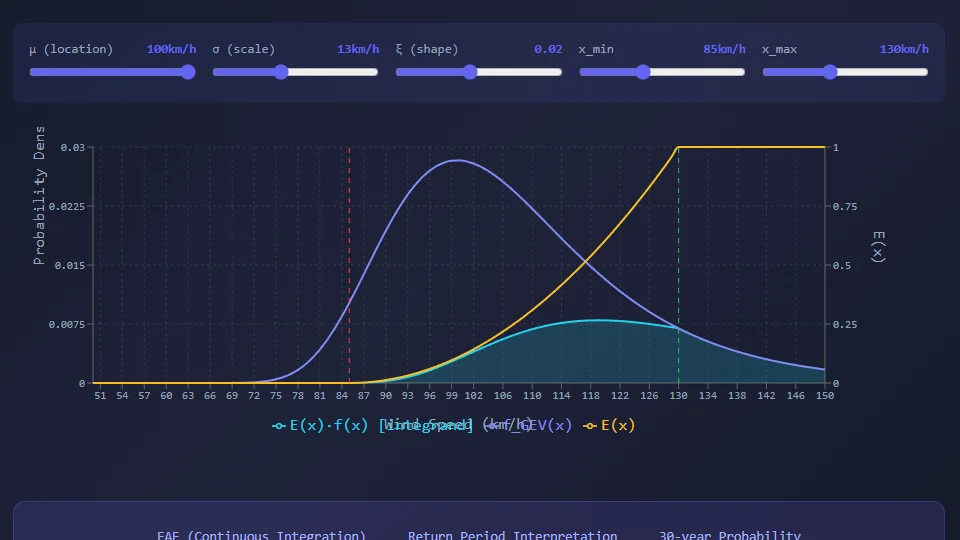
This supplementary article accompanies Part 4 and clarifies a common point of confusion: the distinction between the IPCC Climate Risk Framework and the CNAIM Risk Framework familiar to many utility asset managers.
How IPCC Climate Risk Framework, EAE, and CNAIM Risk frameworks actually relate:
┌──────────────────────────────────────────────────────────────────────┐
│                COMPLETE RISK FRAMEWORK RECONCILIATION                │
├──────────────────────────────────────────────────────────────────────┤
│                                                                      │
│  IPCC AR6:   Risk = f(Hazard, Exposure, Vulnerability) × Consequence │
│                        ↓         ↓            ↓              ↓       │
│                       f(x)      E(x)      Fragility(x)      CoF      │
│                        │         │            │              │       │
│                        └────┬────┘            │              │       │
│                             ↓                 │              │       │
│  EAE Step:          ∫ f(x)·E(x) dx            │              │       │
│                     = Expected Annual         │              │       │
│                       Exposure                │              │       │
│                             │                 │              │       │
│                             └────────┬────────┘              │       │
│                                      ↓                       │       │
│  PoF Step:              ∫ f(x)·E(x)·V(x) dx                  │       │
│                         = Annual Probability                 │       │
│                           of Failure (Climate)               │       │
│                                      │                       │       │
│                                      ↓                       │       │
│  CNAIM:                     PoF_total × CoF = Risk           │       │
│                                ↑                             │       │
│                                │                             │       │
│                    ┌───────────┴───────────┐                 │       │
│                    │                       │                 │       │
│              PoF_baseline            PoF_climate ←───────────┘       │
│              (Condition,Age,         (From hazard ×                  │
│               Environment)            fragility)                     │
│                                                                      │
└──────────────────────────────────────────────────────────────────────┘
Breaking Down Each Framework
1. IPCC Climate Risk Framework (Conceptual)

This is a conceptual framework—it tells you the components, but not the math.
2. Expected Annual Exposure (Quantifying Exposure)
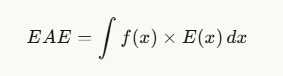
- f(x) = Hazard PDF (how often does intensity x occur?)
- E(x) = Exposure response (what stress/demand at intensity x?)
- EAE = Expected annual exposure (NOT failure probability)
Example interpretation: EAE = 0.09 means "9% expected stress utilization per year" or "equivalent to 0.09 damaging events per year"
3. Climate PoF (Adding Vulnerability/Fragility)
To get actual probability of failure, you need the fragility curve:

Or if E(x) represents stress ratio:

This is where the "vulnerability" component enters.
4. CNAIM Framework (Traditional Asset Management)
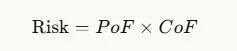
Where CNAIM's PoF includes:
- Health Index (condition, age, defects)
- Environmental factors (generic: corrosion, pollution)
- Loading factors (utilization)
Critical insight: CNAIM's PoF does NOT explicitly model climate hazard distributions. It uses average historical failure rates, not probabilistic climate projections.
The Reconciliation: Where is Exposure in CNAIM?
Exposure is partially "baked into" CNAIM, but incompletely.
CNAIM captures exposure through:
- Location environment category (coastal, industrial, rural)
- Distance from coast (corrosion proxy)
- Pollution level (insulator degradation)
But this is:
- Static - doesn't capture changing climate
- Non-probabilistic - not based on hazard intensity distributions
- Generic - not specific to each hazard type
- Backward-looking - based on historical conditions
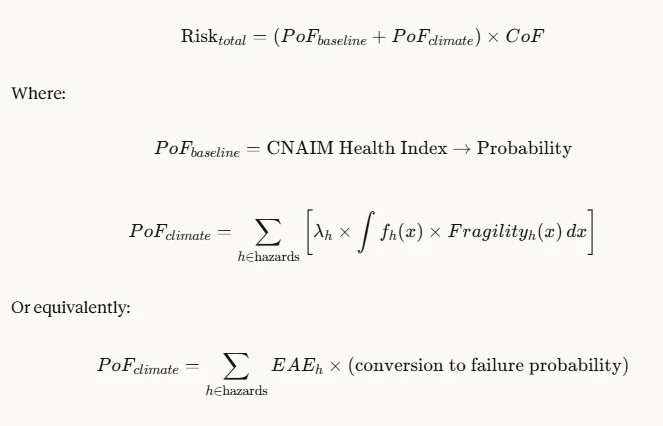
The Complete Formula: Integrating Both Approaches
For climate-informed asset risk:
Clarifying E(x) Interpretation Options
The interpretation of E(x) determines what EAE means:
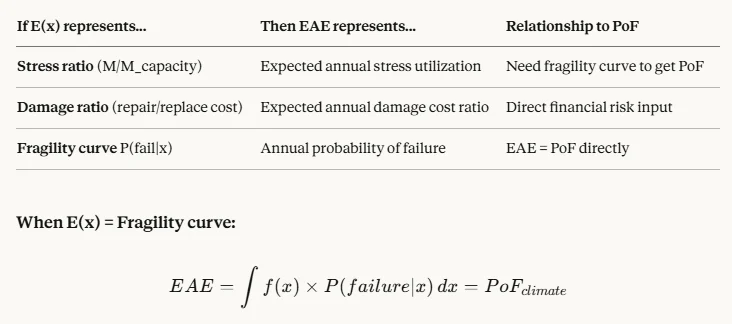
This is the special case where EAE directly equals the climate-driven probability of failure.
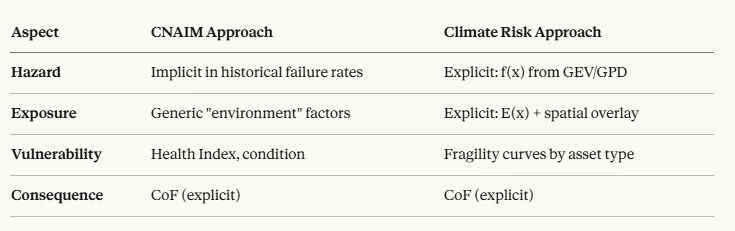
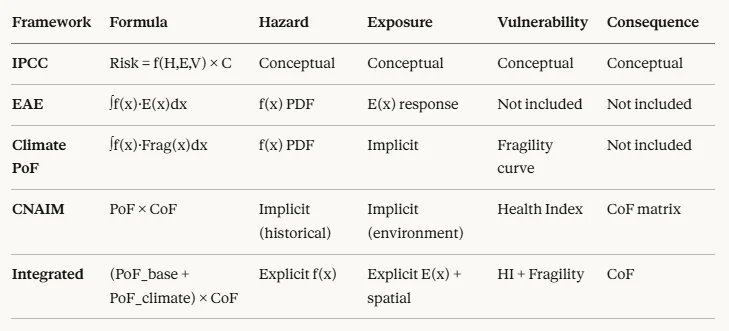
Summary Table: Framework Reconciliation
Visual Summary
                          CNAIM (Traditional)
                         ┌─────────────────────┐
                         │   PoF_baseline      │
                         │   (Age, Condition,  │
                         │    Environment)     │
                         └──────────┬──────────┘
                                    │
                                    ↓
                         ┌──────────┴──────────┐
                         │                     │
     Climate Risk        │    PoF_total        │         Consequence
    ┌──────────────┐     │         ×           │     ┌──────────────┐
    │  PoF_climate │ ──→ │                     │ ←── │     CoF      │
    │              │     │                     │     │              │
    │ = ∫f(x)·V(x) │     └──────────┬──────────┘     │ (Customers,  │
    │              │                │                │  Safety,     │
    └──────┬───────┘                ↓                │  Financial)  │
           │                  ┌─────────┐            └──────────────┘
           │                  │  RISK   │
           │                  └─────────┘
           │
    ┌──────┴───────────────────────────────┐
    │                                      │
    │   f(x) = Hazard PDF (GEV/GPD)        │
    │          ×                           │
    │   V(x) = Vulnerability (Fragility)   │
    │          ×                           │
    │   [Spatial Exposure: is asset here?] │
    │                                      │
    └──────────────────────────────────────┘
Key Takeaways
- f(x) is hazard intensity PDF, not PoF — it answers "how often does intensity x occur?"
- E(x) is exposure response, not PoF — it answers "what happens to the asset at intensity x?"
- Fragility/Vulnerability converts exposure to failure probability — P(failure | intensity x)
- CNAIM's PoF has exposure baked in implicitly through generic environment factors, but this is static, backward-looking, and non-probabilistic
- Climate risk adds explicit, forward-looking, probabilistic hazard modeling on top of the CNAIM baseline
- Complete integration: Risk = (PoF_CNAIM + PoF_climate) × CoF